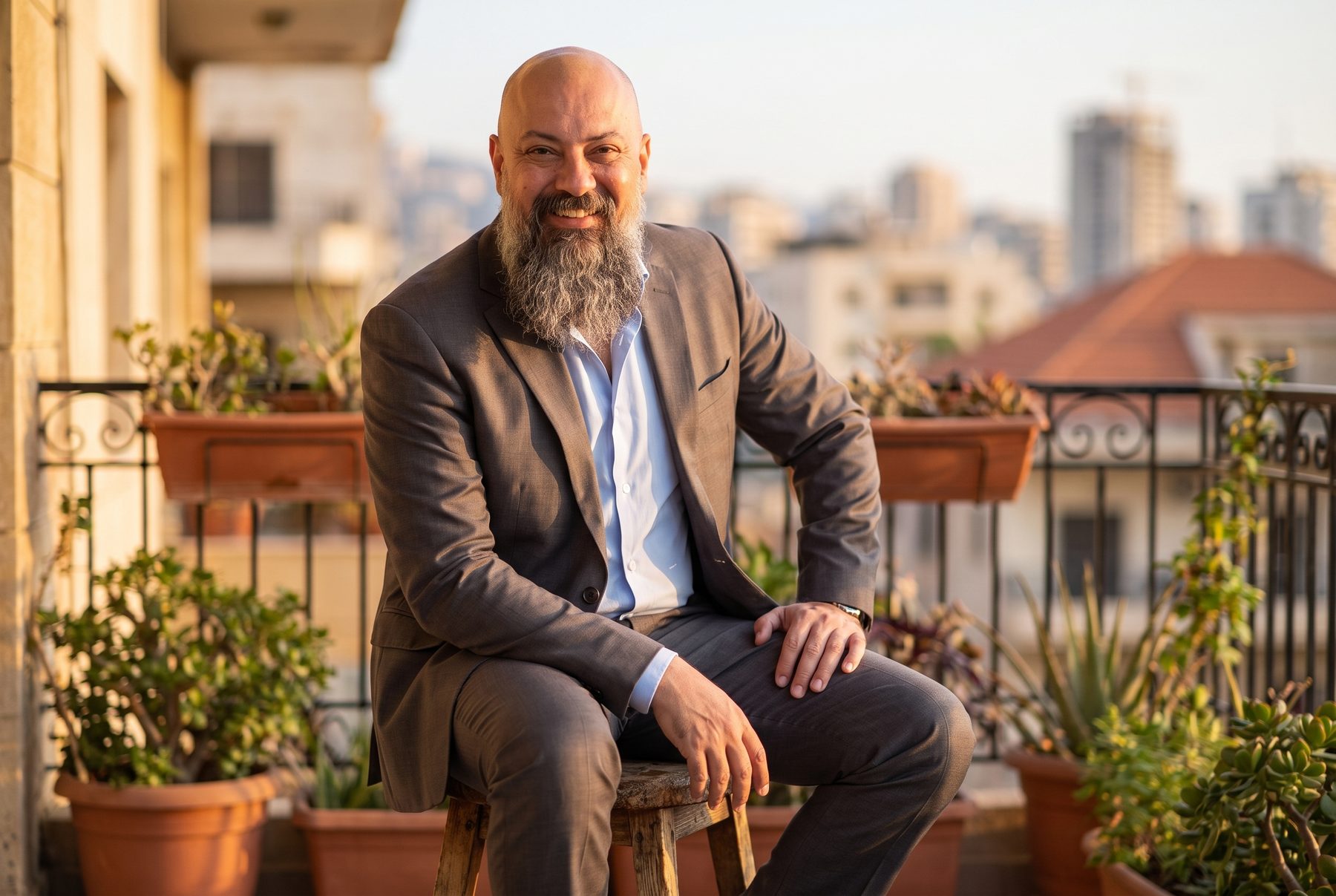
by Maher Akiki
This is not a book about money. Or — it is, the way a book about a river is also about everything the river carries away with it.
I will be honest with you from the first page, because the whole thing falls apart otherwise: I am not writing this from above you. I am in it too. We all are. I live in a country where the ground has never once been steady, where crisis is not an event but a climate — and maybe because of that, we long ago agreed on a single way to measure whether a person's life has worked. We measure it in money. We have been measuring it in money for so long that most of us have forgotten it is only one instrument, and a crude one, and that it lies.
It lies in both directions. It hides failure behind the man who has everything and feels nothing. It hides success behind the man who has little and sleeps soundly. And almost no one stops to check the reading against the things that actually make a life — the people at your table, your health, your freedom, your peace, the days you spend with the ones you love before there are no more days to spend. None of these appear on the statement. So, quietly, over a lifetime, we stop counting them.
Here is the only thing I am really asking you to do, in this entire book: look. You will not see what the money is costing you if you are not looking — and the work, the earning, the chasing, the next thing and the next, is very good at keeping you from looking. It kept my father from looking for seventy years.
My father is eighty-seven years old. Last month he sold his shop, because after the surgery he could no longer stand behind the counter, and a man who cannot work, in his mind, has nothing to do with his hands or his day. So he is home now. He sits. He goes over his life the way other men read the newspaper — once in the morning, once at night, looking for something he keeps not finding.
He is a simple man. Uneducated, hardworking, law-abiding, a man of faith. He built everything he had with his own two hands and asked no one for help. He followed his path — a Maronite, faithful to it — built a family, raised his children, loved and respected his wife for a lifetime. By every measure his faith asked of him, he succeeded. By every measure the country taught him to respect, he succeeded too. He provided. His children ate, studied, saw the doctor, wanted for nothing. He spent almost nothing on himself. He did, exactly and faithfully, what a good man is told a good man does — and he was, by any account anyone could name, a good man.
And three times, the country took it all back.
In the eighties the currency collapsed and his savings turned to paper. So he built a building, to live out his old age on the rent — and the state froze the rents for a generation, until he had to sell the apartments at a loss just to get through the next crisis. So he started again, and put what he could into the bank, where money is supposed to be safe. In 2020 the banks closed their doors with his life's work still inside them.
Each time, he had the same answer. Work harder. It was the only answer he knew, and it was a good answer, and it never once failed to do its quietest job — keeping him from the question underneath everything: what is all of this for? He never had to ask it. There was always another lira to earn first. The work was the wall he built between himself and the question, and it held for seventy years.
Then, in a short and merciless span, the walls came down together. My mother — his wife of a lifetime — died while he was in the hospital. His own health broke. After the surgery he could no longer stand behind the counter, so the shop was sold. The partner, the body, the work: gone almost at once. And in the silence they left behind, the question he had outrun his whole life finally walked in and sat down across from him — at eighty-seven, with no years left to answer it any differently than he already had.
I want to be careful here, because it would be easy to read this as the story of a man who chased money and was foolish to. He was not foolish, and he did not stray. By the faith he lived and the duty he was raised to, he did everything right, to the very end. That is the part that should unsettle you, as it unsettles me: this is not a man who failed his measures. He passed them — all of them. And the question still came. Because the question was never asking whether he had been a good man, or a faithful one, or a good provider. He was all three. It was asking something the ledgers were never built to measure, and meeting every obligation perfectly does not answer it.
If you set the money aside and use the honest ledger instead, the one with people and days on it, the accounting reads differently. He has four children. Two left long ago and rarely return. Half his bloodline lives on the other side of the world — grandchildren, and their children, whose faces he has never seen and likely never will. This is not estrangement; no one did anything wrong. They left to build good lives, exactly as they were raised to. He provided so well, so completely, that his children could afford to build those lives elsewhere — and the full success of that provision is measured, at the end, in the distance it created. The thing he optimized for produced the very emptiness that surrounds him now.
All the money in the world will not make up for a day lost with a loved one.
I cannot tell you what my father concludes when he sits in that empty room, because he has not handed me the words and I will not put them in his mouth. But I am his son, and I have watched. I have seen the grief, and the way he stands tall and keeps himself busy so he does not have to face his own relentless mind, and the way the room is quiet now in a way it was never allowed to be before. And I have heard the question take its plainest form: now what. I lived, I worked, I married, I had children, I made money and lost it, I held grandchildren, I grieved, I laughed — and now there is a little health left, and the thing I find myself asking is whether I will make it to next winter.
The year before my mother died, he and I were at a gathering of the basketball club he helped found. Every year they honor the oldest living founding member. That year it was him — which is only another way of saying that every man who once sat above him on that list was gone. He understood exactly what the honor was. He turned to me and asked whether he would still be alive the next year to sit in the chair again. It hurt him to ask it, and it hurt to hear.
Sit with what that question is. After a lifetime spent earning a currency, the only currency he wanted at the end was the one that was never for sale — another winter, another meeting, another day. Not more money. Time. The very thing the money was supposed to secure and never could, and never can. The whole of what I am trying to say to you lives inside the question my father asked me in that room.
And here is the cruelest part, the part that turns his story from sadness into warning. For a younger person, seeing this clearly is a gift — you can still act on it; clarity becomes a tool in your hands. For my father, clarity can only become remorse, because the seeing arrives decades after the power to do anything about it. The window where insight could have bent the path has closed. That is the one thing you still have that he does not. Your clarity can still change your life. His can only narrate it back to him.
So this book is not me, enlightened, explaining money to you. I told you — I am in the same water. The only thing I can claim is that I started looking a little sooner, because I watched what a lifetime of not looking does, up close, in the one person I could not look away from. I am still learning to look myself. That is all enlightenment turns out to be, as far as I can tell: not arriving anywhere, just being willing to ask the question while you still have the years to answer it.
Most people never ask it. The work will not let them. And I understand why — the question is frightening, and the running feels like responsibility, like love, like exactly what a good person ought to be doing. My father thought so for seventy years, and he was not wrong to love his family or to work for them. He was only never given a second way to count. I am asking you to stop, just long enough to look at your own ledger. The real one. The one with the people and the days on it — while the looking can still be a tool, and not yet a regret.
You will not see it if you are not looking.
Let's look together.